Build awareness of how cultural differences can profoundly impact people in an organization.
Motivate participants to rethink their behavior and attitude toward others.
Allow participants to examine their own bias and focus on how they perceive differences.
Examine how stereotypes are developed, barriers created, and misunderstandings magnified.
Identify diversity issues within the organization that must be addressed. BaFa'BaFa' initiates immediate, personal change. This simulation makes participants personally aware of the issues around culture differences. Participants feel the alienation and confusion that comes from being different. BaFa'BaFa' shakes participants out of thinking in stereotypes of anyone who is different. They learn the value of all faces in the workplace in a safe, stimulating environment.
Updates, reflections and developments as we explore the importance of intercultural issues in education at Bangkok Patana School.
Thursday, 28 April 2011
BaFaBaFa A Culture Simulation
Wednesday, 27 April 2011
What Symbols Represent Your Culture? A Lesson Plan
Matt Jones (Head of Year 10) writes:
In addition to ‘celebrating diversity’, interculturalism in an international school setting should also allow for opportunities to celebrate similarities.
Patana’s IB Psychology students understand the need to consider both ‘emic’ (culturally-specific) and ‘etic’ (universal, cross-cultural) factors when examining cultural norms, differences and similarities. With this in mind, Year 10 students had the opportunity to share ‘symbols’ - personally meaningful aspects of their own cultural identity – with their classmates. It was an opportunity to learn a little more about each other and to exhibit a bit of pride in their own backgrounds. Symbols ranged from national football shirts to soap opera theme tunes: what would you pick as a meaningful representation of your cultural identity?
All credit to Grant Robertson, Head of Secondary English, for developing this excellent lesson. See the plan below.
Discussion on Ethics
2) Intelligence is increasing
Term 2 Magazine Article
Wednesday, 6 April 2011
Intercultural Competence – Who Cares?
Image: Some rights reserved by Bernt Rostad
Ettie prefers not to use the word ‘country’ in such discussions and discourages the word ‘international’ as countries/nations are political constructs which, she argues, often do not reveal enough about the culture of a particular person.
The iceberg model of culture
Ettie urges us to look beyond the four F’s (flags, festivals, food, fashion). Schools are at risk of being satisfied that the celebrations of these are somehow enough for addressing intercultural education. She discussed the iceberg theory of culture, distinguishing between ‘visible’ culture and ‘deep’ culture. She noted, too, that there are other metaphors such as the onion with its many layers.
Other than celebrations of the more visible and surface elements of culture, for many educators intercultural education is not their highest priority. Acknowledging this, it is important to engage colleagues. More than simply raising the profile of intercultural education, it is important to facilitate intercultural education amongst staff. On this matter, it is essential to include locally-hired staff (and not only teaching staff) who often have to contend with a dramatic change of culture between home and school.
Defining culture
Ettie moved on to some of the definitions and characteristics of culture, and these are useful pointers. Culture is:
- the way we think, feel, act and plan our future
- based on our personal history and social history
- learned, not genetically inherited (although Ettie raised the possibility that the two main gender ‘cultures’ have some genetic basis)
- pervasive
- the total of things people learn
- shared patterns of behaviour
- shared rules for behaviour
- how you see and interpret your world
- standards of behaviour
Image: Some rights reserved by jack dorsey
Asking questions of people’s culture
It is important to ask other people about their culture(s). This can be difficult, however, because we risk offence. Despite this, Ettie says it is important to foster a community in which it is OK to ask these questions, but also one that knows how to do so without causing offence.
In pairs, we asked each other a question: What is the origin of your name(s)? This is an excellent activity and when conducted with adults certainly led to interesting cultural references, allowing participants to learn lots about each other. It is an easy activity as it is non-threatening (unlike, say, discussions of money and relationships). It holds huge potential for initiating discussions amongst students but Ettie recommends encouraging the students to do the ground work first, perhaps as homework – skype their grand parents, etc. This will get families talking at home about their culture which is itself a vital aspect of meaningful intercultural education.
Third Culture Kids or TCKs
It is important for ‘third culture kids’ to be able to tell a story about their lives, and such explorations of their cultural heritage allow this. Questions like this can be part of what Ettie called ‘roots projects’ which she argues are enormously valuable learning opportunities.
Bird s do not see the sky, nor fish the water, not unless the bird is plucked out of the sky and the fish is taken out of water. (Thai Proverb via Chamnongsri Hanchanlash, Thai Poet, 2004).What happens when you go and/or live in a different culture? Ettie noted that there is a big difference between youngsters making such moves and adults doing the same, since adults already carry a lot of culture with them. The child is a bit more confused as their identity has not yet been formed in the same way during their formative, developmental years.
“Common sense is the collection of prejudices acquired by age eighteen”. Ettie put forward the argument that TCKs might be “colour blind” – they do not perceive cultural or ethnic differences the same way that others more heavily attached to a ‘home’ culture do, although I have to say that I think this is very debatable … my experiences tell me that children do become acutely aware of such differences, regardless of cultural inheritance.
Ettie extended her argument by asking whether TCKs really understand the concept of the ‘other’. Do they ask each other questions about their culture? She says that the answer to this is ‘not often’ and that if they do in fact learn to ask these questions, they’ll understand each other better. A further question: Do they really know enough about their own culture?
Ettie then posed questions about staff within an International School. Do the faculty become inter-culturally competent? Do the faculty ask each other questions about their culture? Again, she says, the answer is ‘not often’, but it could be very healthy to do so in terms of mutual understanding. Ultimately, do our international schools facilitate these deep discussions?
Misunderstandings in cross-cultural communication often begins with a misunderstanding of ourselves.
Yamada 1997
Image: Some rights reserved by Keo 101
Definitions
Do we confuse intercultural literacy/competence, international mindedness and global citizenship?
In exploring the differences, Ettie suggests an exercise that interested staff might undertake. In groups they could answer these questions and look for commonality and difference amongst answers:
- What do interculturally literate persons look like? What do they do? How do they think?
- What do internationally minded persons look like? What do they do? How do they think?
- What do global citizens look like? What do they do? How do they think?
What do we mean by ‘cultural literacy’? Simply, can we read others? It is, for example, not always easy to interpret people’s responses in terms of gestures, facial expressions or body language if they are from other cultures.
What is an internationally-minded person?
(Note the influence of CIS here):
- She has the knowledge , multilingual and technology skills required to succeed in a global economy;
- She has the attitudes and skulls of intercultural competency and understanding of the ‘other’
- She has an understanding of world issues, empathy and caring towards people different from themselves
- She has an attitude of caring and advocacy
Ettie’s view: Maybe this needs a teacher grassroots movement to push this agenda. A bottom up approach, rather than trying to impose intercultural initiatives from a top-down direction.
Image: Some rights reserved by dierk schaefer
Plenary Discussion
Ettie confirmed that there is a lot of really good stuff out there on intercultural training. I referenced the work of the American Peace Corps on this theme.
We should avoid discussions being led exclusively by opinion and give staff concrete research articles to review.
Ettie pointed out how intercultural competence is deeply embedded both in the new CIS standards and in the IB diploma, and commented that there will be increasing focus on all of this within international education.
Malcolm Mackenzie argues that International Schools could serve as a bridge between cultures but we definitely have to get staff on board – Ettie warns that it could be a ‘hard sell’. One strategy which she suggests here is for advocates to apply for professional development to be a cross-cultural trainer.
Image: Some rights reserved by avlxyz
Notion from Gerritz (2004): Give students transportable ‘gifts’.
So, on to some more ways forward … Give our students an enthusiasm for internationalism. Create world citizens through service learning, geography and history, particularly current history. Measure their progress on their understandings/attitudes toward internationalism. Use surveys to test people to see if there is improvement in people’s intercultural competence.
References
Finally it is worth noting that Ettie referenced the following articles in her presentation:
Betts, Bambi (2007) ‘The Challenge of Global Citizenship in our Schools’ The International Educator
Mackenzie, Malcolm (1998) ‘Going, Going, Gone .. Global!’ in McHayden and Thompson (eds) International Education: Principles and Practice [London: Kogan Page]
James Penstone
Wednesday, 23 March 2011
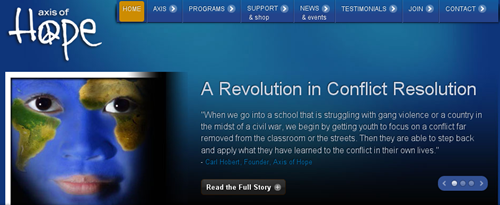
Axis Of Hope – Encouraging Conflict Resolution Skills
The Axis of Hope website explains the approach here, and this quote reveals how the role-play method also helps to promote intercultural competence amongst young people:
Axis of Hope uses its unique case study approach to bring matters of international importance right into the classroom. These case studies have been thoughtfully constructed so as to avoid biases or prejudices and present only the facts. Furthermore, they are designed to promote interactive learning so that each case study includes … six different perspectives of the conflict allowing students to see through the different lenses of those involved. These perspectives are what allow our students to empathize with the involved parties as well as adopt a position and stance from which they can then negotiate.This video at a little over 5 minutes explains the Axis of Hope approach more, and rings true to the potential which this approach holds (as I saw it today) in terms of global citizenship, lifelong learning and international mindedness:
This was a refreshing and stimulating workshop in which we started on a typical course schedule which Carl has shared with countless groups of students throughout the world. We ended by reflecting on the potential which such workshops could hold in our own schools and reflecting on the valuable experiences offered by the annual trips led by Carl and his team to Rwanda.
Here are ten of my reflections and notes from the course (with an emphasis on the theme of intercultural education):
1) Icebreaker activities really can work when preparing to listen to the viewpoints of others – Carl suggested we seek out engaging icebreaker activities from the Outward bound website. I couldn’t find these specifically, but did find these (including these focused on interculturalism) and also this useful list on a MS Word document.
2) Quizzes based on current world events can help open up useful discussions that are accessible and engaging for students.
3) Intercultural competence requires strong listening skills, and simulating conflict resolution certainly promotes these.
4) Paired introductions (in which two people are given 10 minutes to learn about each other and then introduce the other to the rest of the group) is a really good ice breaker in itself, but the same concept could also be applied to finding out about and introducing another person’s cultural heritages.
5) The ‘preventive diplomacy’ which Carl advocates requires well developed media literacy. The workshop gave practical examples of this – find a world issue that involves a number of international stakeholders, such as news items concerning Arab-Israeli conflict, and access the same issue as reported on by a variety of news agencies within the different stakeholder countries and regions. Use this to identify and explore bias, so gaining a fuller appreciation of different cultural viewpoints.
6) Another participant used the phrase ‘supernationalism’ to refer to a globalised, connected ‘flat’ world without borders.
7) Carl used the phrase G.Q. as in Global Quotient in terms of a person’s international-mindedness and global awareness, something which can be explored through quizzes (as above).
8) While such role-plays do require the student to develop a useful historical awareness of the case-study in question, the broader emphasis is on developing interpersonal skills above learning curricular content.
9) Carl advises that when we commit to community-focused service, such as improving a road in a Rwandan village, we should do it as part of a team and be humble about it. Don’t take pictures of the event, don’t seek credit. Walk away and focus meaning on the collaborative experience itself.
10) Carl and participants gave these book recommendations:
-
Mountains Beyond Mountains: The Quest of Dr. Paul Farmer, a Man Who Would Cure the World by Tracy Kidder
- Rethinking Globalization: Teaching for Justice in an Unjust World by Bill Bigelow and Bob Peterson
- Half the Sky: Turning Oppression into Opportunity for Women Worldwide by Nicholas D. Kristof and Sheryl WuDunn
- The Rise and Fall of the Great Powers by Paul M. Kennedy
Thursday, 10 March 2011
Blog: Culturally Teaching
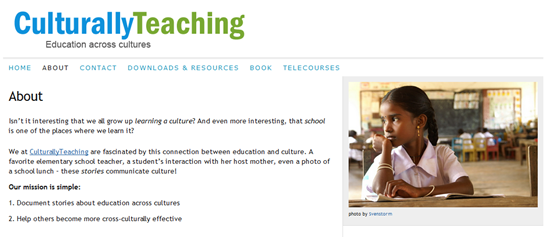
This is an impressive blog which carries the tagline ‘Education across Cultures’. Well worth following, it provides a lot of experience-related ideas and links to some useful resources on intercultural education.
Quoting from their ‘About page’:
Isn’t it interesting that we all grow up learning a culture? And even more interesting, that school is one of the places where we learn it?
We at CulturallyTeaching are fascinated by this connection between education and culture. A favorite elementary school teacher, a student’s interaction with her host mother, even a photo of a school lunch – these stories communicate culture!
Our mission is simple:
1. Document stories about education across cultures
2. Help others become more cross-culturally effective
Source: http://culturallyteaching.com/about/
Here is a sample of popular blog posts:
Sleeping in School - A Cultural Thing?
What Do Bread, Brot and Education Have in Common?
"Checking" Assumptions in the Classroom
I particularly enjoyed this post:
Inter-Cross-Global-Learning-MindednessVisit CulturallyTeaching here.