Today at Earcos Teachers’ Conference 2011, I attended an excellent pre-conference workshop hosted by Prof. Carl Hobart, founder of the non-profit organisation Axis of Hope. This organisation actively encourages young people to develop conflict negotiation skills through relevant and carefully managed role-play exercises. The ultimate aim is to equip students with the skills and motivation to prevent conflict through the local to global scale, both now and later in life.
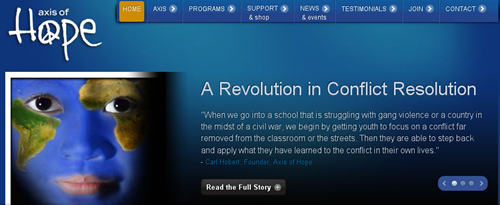
The Axis of Hope website explains the approach here, and this quote reveals how the role-play method also helps to promote intercultural competence amongst young people:
This was a refreshing and stimulating workshop in which we started on a typical course schedule which Carl has shared with countless groups of students throughout the world. We ended by reflecting on the potential which such workshops could hold in our own schools and reflecting on the valuable experiences offered by the annual trips led by Carl and his team to Rwanda.
Here are ten of my reflections and notes from the course (with an emphasis on the theme of intercultural education):
1) Icebreaker activities really can work when preparing to listen to the viewpoints of others – Carl suggested we seek out engaging icebreaker activities from the Outward bound website. I couldn’t find these specifically, but did find these (including these focused on interculturalism) and also this useful list on a MS Word document.
2) Quizzes based on current world events can help open up useful discussions that are accessible and engaging for students.
3) Intercultural competence requires strong listening skills, and simulating conflict resolution certainly promotes these.
4) Paired introductions (in which two people are given 10 minutes to learn about each other and then introduce the other to the rest of the group) is a really good ice breaker in itself, but the same concept could also be applied to finding out about and introducing another person’s cultural heritages.
5) The ‘preventive diplomacy’ which Carl advocates requires well developed media literacy. The workshop gave practical examples of this – find a world issue that involves a number of international stakeholders, such as news items concerning Arab-Israeli conflict, and access the same issue as reported on by a variety of news agencies within the different stakeholder countries and regions. Use this to identify and explore bias, so gaining a fuller appreciation of different cultural viewpoints.
6) Another participant used the phrase ‘supernationalism’ to refer to a globalised, connected ‘flat’ world without borders.
7) Carl used the phrase G.Q. as in Global Quotient in terms of a person’s international-mindedness and global awareness, something which can be explored through quizzes (as above).
8) While such role-plays do require the student to develop a useful historical awareness of the case-study in question, the broader emphasis is on developing interpersonal skills above learning curricular content.
9) Carl advises that when we commit to community-focused service, such as improving a road in a Rwandan village, we should do it as part of a team and be humble about it. Don’t take pictures of the event, don’t seek credit. Walk away and focus meaning on the collaborative experience itself.
10) Carl and participants gave these book recommendations:
The Axis of Hope website explains the approach here, and this quote reveals how the role-play method also helps to promote intercultural competence amongst young people:
Axis of Hope uses its unique case study approach to bring matters of international importance right into the classroom. These case studies have been thoughtfully constructed so as to avoid biases or prejudices and present only the facts. Furthermore, they are designed to promote interactive learning so that each case study includes … six different perspectives of the conflict allowing students to see through the different lenses of those involved. These perspectives are what allow our students to empathize with the involved parties as well as adopt a position and stance from which they can then negotiate.This video at a little over 5 minutes explains the Axis of Hope approach more, and rings true to the potential which this approach holds (as I saw it today) in terms of global citizenship, lifelong learning and international mindedness:
This was a refreshing and stimulating workshop in which we started on a typical course schedule which Carl has shared with countless groups of students throughout the world. We ended by reflecting on the potential which such workshops could hold in our own schools and reflecting on the valuable experiences offered by the annual trips led by Carl and his team to Rwanda.
Here are ten of my reflections and notes from the course (with an emphasis on the theme of intercultural education):
1) Icebreaker activities really can work when preparing to listen to the viewpoints of others – Carl suggested we seek out engaging icebreaker activities from the Outward bound website. I couldn’t find these specifically, but did find these (including these focused on interculturalism) and also this useful list on a MS Word document.
2) Quizzes based on current world events can help open up useful discussions that are accessible and engaging for students.
3) Intercultural competence requires strong listening skills, and simulating conflict resolution certainly promotes these.
4) Paired introductions (in which two people are given 10 minutes to learn about each other and then introduce the other to the rest of the group) is a really good ice breaker in itself, but the same concept could also be applied to finding out about and introducing another person’s cultural heritages.
5) The ‘preventive diplomacy’ which Carl advocates requires well developed media literacy. The workshop gave practical examples of this – find a world issue that involves a number of international stakeholders, such as news items concerning Arab-Israeli conflict, and access the same issue as reported on by a variety of news agencies within the different stakeholder countries and regions. Use this to identify and explore bias, so gaining a fuller appreciation of different cultural viewpoints.
6) Another participant used the phrase ‘supernationalism’ to refer to a globalised, connected ‘flat’ world without borders.
7) Carl used the phrase G.Q. as in Global Quotient in terms of a person’s international-mindedness and global awareness, something which can be explored through quizzes (as above).
8) While such role-plays do require the student to develop a useful historical awareness of the case-study in question, the broader emphasis is on developing interpersonal skills above learning curricular content.
9) Carl advises that when we commit to community-focused service, such as improving a road in a Rwandan village, we should do it as part of a team and be humble about it. Don’t take pictures of the event, don’t seek credit. Walk away and focus meaning on the collaborative experience itself.
10) Carl and participants gave these book recommendations:
-
Mountains Beyond Mountains: The Quest of Dr. Paul Farmer, a Man Who Would Cure the World by Tracy Kidder
- Rethinking Globalization: Teaching for Justice in an Unjust World by Bill Bigelow and Bob Peterson
- Half the Sky: Turning Oppression into Opportunity for Women Worldwide by Nicholas D. Kristof and Sheryl WuDunn
- The Rise and Fall of the Great Powers by Paul M. Kennedy
James Penstone