Wednesday, 2 February 2011

UNESCO Guidelines on Intercultural Education

image

A 43 page document, with a clear emphasis on the notion of human rights and the role that intercultural education has to play with promoting and guaranteeing human rights.

The preface reads as follows:

The Member States of UNESCO’s governing body have requested the
Organization to continue to “strengthen initiatives in the development of
materials for education and intercultural and interfaith understanding”*. At
the same time the World Programme for Human Rights Education as a UN initiative, coordinated jointly by UNESCO and the OHCHR, lays emphasis on the need for tolerance and respect of all peoples in the world through the inclusion of human rights principles in the school and the curriculum.

These Guidelines have been prepared as a contribution to the understanding of the issues around intercultural education. They draw together the key standard-setting instruments and the results of numerous conferences, in particular, the Expert Meeting held at UNESCO Headquarters in March 2006, in order to present those concepts and issues which may be used to guide future activities and policy making in this area.

The document reflects UNESCO’s unique role as international standard setter and convenor of diverse cultural and ideological perspectives. It is hoped that it will serve as a valuable practical resource for teachers and learners, curriculum developers, policy makers and community members alike, and all those who wish to promote Intercultural Education in interests of peace and understanding.

Hosted by UNESCO.

Wednesday, 12 January 2011

Culture - The Space between the Bars, the Silence between the Notes by Paul Poore

image

Image: Some rights reserved by tanakawho

Paul Poore, Director of Harare International School, is a preeminent thinker and leader regarding interculturalism in education. Click below to access an excellent speech which he dlivered as the Association for the Advancement of International Education's Distinguished Lecture in 2005. 

Culture - The Space between the Bars, the Silence between the Notes by Paul Poore

[Hosted on http://www.nshss.org/]

Presentation by Deepa: Building Acceptance, Bridging Differences

On 20th November last year, Deepa hosted a 'job-alike workshop' addressing issues of how to effectively incorporate intercultural education into a school's curriculum and ethos. Here, at the end of this post, is the presentation which she developed to start valuable discussion with.

As a result of the productive discussion which followed from this, the following documents were collectively arrived at by the attendees:

1) Definitions of Interculturalism

2) Interculturalism - DEPA - BTN - Lesson Plan Tutorial Programme 1

3) Interculturalism - DEPA - BTN - Lesson Plan Tutorial Programme 2


Tuesday, 11 January 2011

Geert Hofstede and Cultural Dimensions

Thanks to Darren for passing this website on. Geert Hofstede has contributed a huge amount of reserach and ideas to the field of interculturalism, and his name is often referenced in contemporary research. Hofstede's work has been used to develop audits and training resources for helping organisations improve their intercultural literacy, as is evident from the website below.

image

http://www.geert-hofstede.com/ developed by ITIM International.

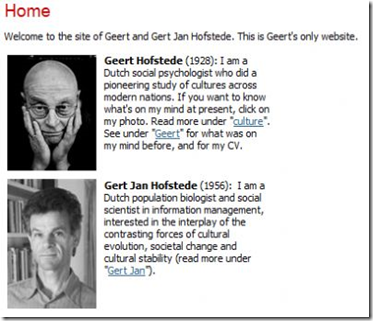
Together with his son, Gert, they share some relevant information on their own website which is here:

image

http://www.geerthofstede.nl/index.aspx

East is East and West is West by George Walker

Thanks to Jane for passing on this valuable article by George Walker hosted on the IB Positions Papers blog. You can access the direct link to the article by clicking the image below.

image

Abstract:

This position paper addresses the long-standing criticism that the International Baccalaureate (IB) is too closely associated with Western values and, despite its title, does not enable students to see the world from a truly international perspective. Considering evidence from different authorities, it analyses the IB learner profile and asks how appropriate it is for the cultures of East Asia. The paper concludes that the learner profile does indeed reflect the strong Western humanist foundations of the IB, but accepts that the organization’s successful growth (not least in its Asia-
Pacific region) makes sudden change unlikely and undesirable. Instead, it recommends that the learner profile be reviewed regularly and used as a focus for internal debate on this issue. It also proposes that some limited regional variation be encouraged in order gradually to seize “the great opportunity for the creation of new thought by a new combination of truths” (Tagore 1961: 222).

Source: http://blogs.ibo.org/positionpapers/files/2010/09/East-and-West_George-Walker.pdf